

Choosing an accountant is a big decision. You’re trusting someone with your finances, your business decisions, and even your future plans. So it’s completely fair to ask if they’re properly qualified.
You might have heard of ACCA before, but what does it mean? And why does it matter?
Pretty much anyone can call themselves an accountant these days, but with a chartered certified accountant, you guarantee they’ve got years of training and experience backing them, they’re regulated and follow a strict code of ethics, and they continue to train hard.
Looking for a chartered certified accountant? See our accounting services or get in touch for advice.
What is an ACCA qualification?
ACCA stands for the Association of Chartered Certified Accountants. It’s a globally recognised professional body for finance professionals, with members from the UK and around the world. An ACCA qualification helps people gain the skills and knowledge needed to become qualified finance professionals, such as accountants, finance managers, and tax specialists.
But it’s not just about passing exams. ACCA members also need to gain practical experience and keep learning throughout their careers.
In short, an ACCA qualification shows that your accountant has been assessed and held to a recognised professional standard.
How can I check whether an accountant is an ACCA member?
Before you hand over your business finances to someone, it’s completely normal to want a bit of reassurance.
Common questions that often pop up include:
- Is this accountant properly qualified?
- Are they regulated?
- Is there someone overseeing their work?
And finding the answers is simple.
You can look up an accountant on the official ACCA website using their online member directory. Just enter their name or firm, and it will confirm whether they’re an ACCA member and whether their membership is current.
It may take a few minutes of your time, but it gives you the peace of mind you need to continue.
Now, take Polaris Accounting for example. Our founder, James, is ACCA qualified. In fact, he’s a Fellow of the Association of Chartered Certified Accountants (FCCA), which means he’s been a qualified member for many years (10 years to be exact) and has kept up with his continuous professional development (CPD) requirements. This is also considered to be a senior ACCA designation.
Take a look at James’ FCCA status for yourself or get in touch for trusted accounting advice.
You’re absolutely allowed to ask about qualifications before you choose an accountant. It’s your business, after all. And a good accountant won’t be offended. In fact, they’ll welcome the question.
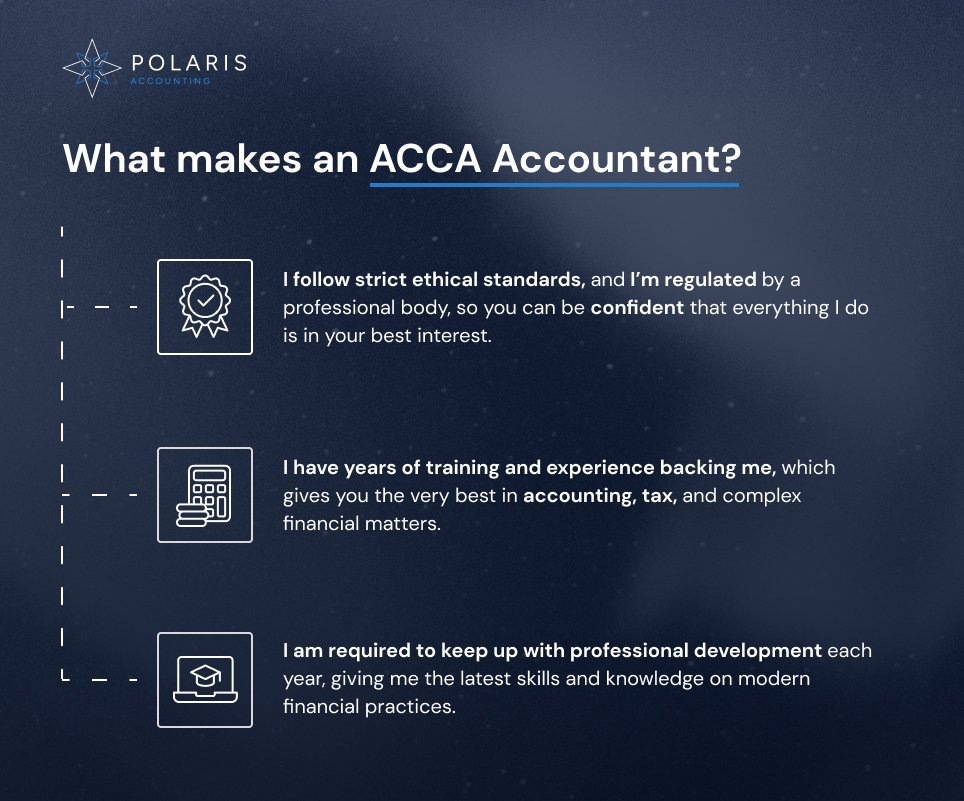
Benefits of working with an ACCA-accredited accountant for your business
So what does all this actually mean for you?
Choosing an ACCA-accredited accountant isn’t about prestige. It’s about knowing your finances are in safe hands and having someone you can trust support your business through growth.
Here are some of the key benefits you’ll experience.
Professional standards and ethics
ACCA members must follow strict ethical standards. For us, it means maintaining integrity, objectivity, and professional behaviour in every instance. And for you, this translates to easy communication, honest advice, and peace of mind that your accountant will always act in your best interest.
Up-to-date technical knowledge
Part of maintaining an ACCA membership means completing continuous professional development, which is what all highly respected accountants should be doing. With ACCA, you can guarantee that your accountant is up to date with the ever-changing tax rules, technology, and finance industry.
Regulatory oversight
ACCA recognises the importance of regulatory oversight. As members, we have been trained to uphold professional standards. We take accountability seriously. If something were to ever go wrong (unlikely, but important), there is a formal complaints and disciplinary process in place.
Broad financial expertise
ACCA exams cover a range of topics, from management accounting to corporate finance to financial reporting and more. That broad training means we can go beyond basic compliance tasks. We can look at specific challenges, analyse your business performance, improve financial management, and help you make clued-up business decisions.
Global recognition and credibility
The ACCA qualification is globally recognised and highly respected. So whether you’re dealing with overseas suppliers or planning future expansion, having a Chartered Certified accountant can be a significant advantage. It provides reassurance that the advice you get is grounded in a qualification trusted worldwide.
Strong practical skills
We’ve got over two decades of accountancy experience behind us. But even if you’re working with a newly qualified ACCA accountant, the ACCA requires members to demonstrate practical skills in real-world environments. That means you’ll have an accountant who is fully aware of the realities of running a business, from cash flow to tax planning.
What is the difference between a Chartered Certified Accountant and a Chartered Accountant?
Like many professions, there are different routes into accounting. Two of the most common are becoming a Chartered Certified Accountant or a Chartered Accountant. Both are respected qualifications. Both involve exams, real-world experience, and strict professional standards.
While these two titles may sound like they were pulled from the same hat, they do have a few differences in their training and backgrounds.
- Chartered Certified Accountant (CCA) – qualified through ACCA and tends to have a broad commercial training, often with a keen focus on business growth, financial management, and international recognition. This makes ACCA accountants a great fit for small and medium businesses looking for someone to dig into the numbers and help them grow.
- Chartered Accountant (CA) – typically qualified through bodies such as the ICAEW (Institute of Chartered Accountants in England and Wales). Their training pathways often include work within larger firms and can lean towards audit, corporate finance, and more complex financial restructuring.
For most business owners, the specific letters matter far less than what sits behind them.
What really matters is that your accountant is properly qualified, regulated by a professional body, and committed to keeping their knowledge up to date.
If those boxes are ticked, you’re in safe hands.
Choose Polaris for trust, transparency, and a long-term accounting partner
At Polaris Accounting, we’re here for your next business steps.
Whether you want to ask us a question about our work or you’re eager to get the ball rolling, drop us a message and we’ll get back to you. Prefer to talk it through? Call us on 01483 399 721.